
Introduction
The trigger for this work has been the news in the open source relating to the issue of a Request for Information (RFI) by the Army on 09 Oct 2025 for a Counter Unmanned Aerial System (C-UAS) grid in the Tactical Battlefield Space (TBS). An attempt has been made to explain various details related to the above C-UAS grid.
The Emerging Concept of Tactical Battlefield Space (TBS)
The work begins by bringing to the perspective the emerging idea of the TBS. To do that, reference is made to a term very common in the land forces domain. It is Tactical Battle Area or the TBA. This term implies the forward area in the battle where tactical level engagements between opposing forces take place. TBA witnesses maneuvers and counter-maneuvers between mechanized forces, tank-to-tank battles and tactical operations undertaken by ground forces that shape the battle at the forward line.
Besides the ground force, the TBA is populated by tanks, mechanized infantry, artillery systems, air defence guns and missile systems, battle-field surveillance and target acquisition grid, electronic warfare (EW) and cyber warfare resources, combat engineers, signal resources, network management elements and more.
Traditionally and over the years the perception of the TBA has been 2D, i.e. something that exists in the length and breadth of the land in the forward zone where the battle has been joined. This perception is gradually becoming inadequate and incomplete as it concerns the land forces. The more relevant concept is of the TBS which includes the TBA and the airspace immediately over it.
The Drone Play in the TBA
The reason for incompleteness in the erstwhile 2D perception of the TBA lies in the emergence of drone and anti-drone warfare in the visual domain of the TBA and the amalgamation of the attack helicopter as integral extension of the land forces in the third dimension. This is explained further.
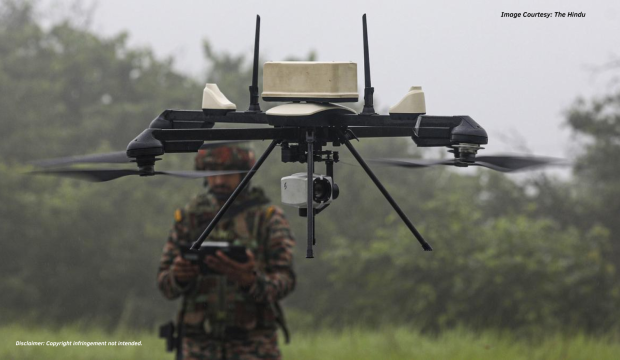
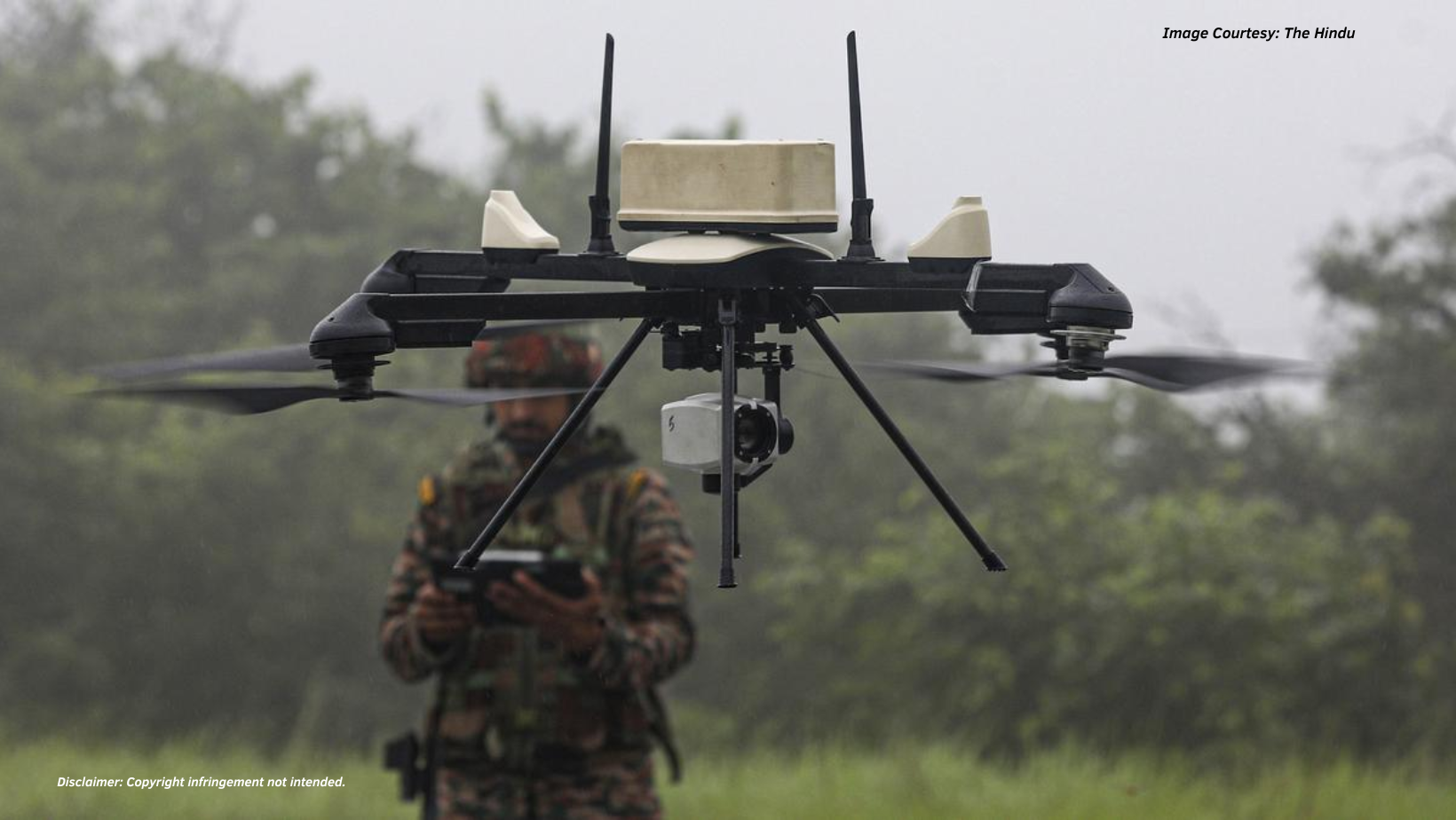
The first ever documented swarm drone attack took place on 05 Jan 2018 when 13 DIY drones struck two Russian assets, namely the Khmeimim air base and the Tartus Naval Base, both in Western Syria. There has been no looking back ever since as regards the emergence of small drones as potent air threat vehicles to prosecute the air threat in the visual domain of the TBA. Small drones have changed the flavour of visual domain air battle in the TBA primarily because of that these air threat vehicles can largely avoid detection by the sensors of conventional air defence radars. This is explained further
Most of the small drones have low Radar Cross Section or RCS. In basic terms RCS (expressed in sq meters) is the measure of the visibility of a target to a typical radar system. Smaller the RCS, more difficult will be for a radar to detect the drone, The current fleet of small drones have an RCS in the region of 0.01-0.4m2 (single rotor – 0.01-0.03m2, quad-copter 0.01-0.10m2, hexa-copter -0.04-0.32m2)1. Compare these to the typical RCS values of strike aircrafts -4GF16 – 5m2, F18-1m2, J 20 – 1m2, SU 35 1-3m2, F35 stealth aircraft -.0015m2).
What is the impact? The conventional sensors associated with main-frame air defence weapon systems are unable to detect small drones and hence unable to direct radar-controlled fire of guns and missiles on them.
What is required to detect these? A whole new lot of sensors based on Electro-Optical (EO)/ Radio-Frequency (RF)/ Infra-Red (IR)/ acoustic technologies or specific radars capable of drone detection called the drone detection radars (DDRs).
For killing the detected drones an entire continuum of soft kill and hard kill measures are required. The soft kill has an extensive arsenal – RF jammers, killer laser beams, EW measures (hacking, phishing, and more) and directed energy weapons like the high-power microwave (HPM) and more. Similarly, the hard kill is also based on diverse weapons from small arms to machine guns, autonomous weapon systems, and high rate of fire air defence guns.
A brief Reference to History
A history of recent wars has shown that whenever a warring side is deficient of the tailor-made anti-drone arsenal in detection and kill, the drones play a havoc while, conventional mainframe air defence weapons stand toothless.
The capitulation of Armenia at the hands of Azerbaijaan riding high on the drone devastation power of Bayractar TB 2 and the Horops in the Nagarno Karabakh conflict or the huge casualties suffered by the Russian mechanised columns advancing in a blitzkrieg into the gut of Ukraine land when faced with the Ukrainian drone power that would become their Brahmastra in times to come… all bear testimony to the fact that if drones don’t meet their befitting counter they will cause disproportionate damage.
Our Scenario
Fortunately, in our scenario, the anti-drone or the C-UAS muscle has grown steadily. Our anti-drone arsenal today is capable of drone detection using multiple means of EO, RF, IR, acoustic and drone detection radars while the kill means have fast extended in all the soft and hard-kill means mentioned above.
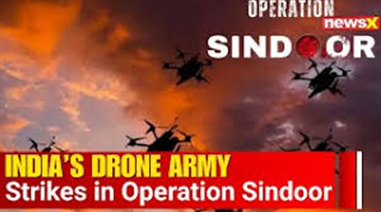
Source: https://www.youtube.com/watch?v=ZuGmhP2bbjM
A good account of our C-UAS muscle was visible during Op Sindoor where our anti-drone systems like the IDD&IS (Integrated Drone detection and kill system) with army air defence and the Zen Anti-drone Systems ( by Zen Technologies limited) both in the soft kill domain coupled with the hard kill C-UAS systems based on the L -70 and ZU 23 air defence guns effectively neutralised the massive drone attacks launched by the adversary. That was only a trailer, the future of drone and swarm drone threat powered by the tools of AI will be much more deadly and would demand a much smarter and stronger response.
Besides the mainframe C-UAS weapons, the capability to counter a drone that appears in a real time on a unit/subunit /mechanised force in the TBA using the intrinsic weapons like small arms, machine guns etc. is resident in the combat unit itself.
Another capability that has played big is the use of drones by our field force be it Infantry, Armoured Corps, Artillery, SATA forces, EW and Cyber forces, combat engineers or more. Drones have proliferated not only to provide the intelligence and surveillance in a typical ‘over the hill scenarios’ but also, for delivering precision strikes with drones/swarm drones in the TBA.
Mainframe threat and defence thereof
Apart from the drone and anti-drone duels unfolding in the TBA the mainframe air threat is also very much relevant and deadly. The word mainframe would imply the threat from such air threat vehicles as the strike aircrafts, attack helicopters, cruise missiles, surface-to-surface missiles (SSMs), anti- radiation missiles (ARMs), loitering munitions, precision guided munitions (PGMs) deployable at standoff ranges, hypersonic threat, directed energy weapons and more.
The fire arm to tackle this threat is the cumulative power of air defence of the nation, viz, air defence and strike aircrafts, an entire spectrum of ground-based air defence weapons (GBADWS) from guns to MANPADS to short medium and long-range SAMs, and the air defence capability of the fleet at sea.
To counter the air threat stated above, the conduct of the air defence battle is a fully co-ordinated and well-knit affair. Very basically, since the threat per se can manifest in any of the domain of land, sea, air, sub-surface etc. either singly or simultaneously, relevant air defence weapons, as mentioned above, exist in each of these domains to take on the threat. Despite this diversity, the air defence fire of each of these weapons is co-ordinated and controlled.
For this, the Indian Air Force in execution of its responsibility of the air defence of the national air space has set up the nation-wide chain for Battle Management Command and Control (BMC2) of air defence battle. This control at the highest level is executed by the Integrated Air Defence Command and Control system (IACCS) consisting of a series of air defence control nodes (comprising of sensors and command, control, and communication infrastructure).
These nodes stretch from the highest level down to the weapon platforms. The IACCS handshakes with the Army’s BMC2 system called Akashteer at the Corps level and therefrom the air defence control chain on the Army grid is through up to the command posts controlling weapons on ground. IACCS similarly handshakes with the Navy’s BMC2 (Trigun -further details not covered.). The air defence control is thus nation-wide and is co-ordinated across inter-Service boundaries.
The BMC2 system referred above is normally called the Air Defence Control and Reporting System or ADCRS.
As stated, the ADCRS infrastructure is composed of long-range early warning sensors and a series of air defence control nodes. Coupled together, these ensure the basic air defence function of air detection, interception and destruction of the air threat duly controlled by the ADCRS system established on the IACCS-Akashteer grid. The entire ADCRS chain is fully automated making possible the execution of the air defence battle in a fast and a fluid mode all in a matter of a few fleeting minutes and seconds.
The Current ADCRS and the threat in the TBA
While the system described above has matured over time and the same showed its worth during Op Sindoor, there are issues when it comes to the emerging threats in the TBA. These are enumerated.
Firstly, the drone component in the TBA needs to be analysed on both sides of the fence.
Anti drone front
- The threat primarily unfolding in the TBA is peculiar. It is large in quantum and almost entirely composed of small RCS threat vehicles.
- Such a threat is unlikely to be detected by the conventional radars associated with mainframe air defence system.
- Also, such a threat operating at ultra-low levels in visual domain in the TBA is unlikely to be detected by the long-range early warning radars that are deployed as a part of IACCS-Akashteer chain.
- In fact, the first sensors which will see this threat will be the EO/RF sensors on board various counter UAS (C- UAS) systems, as well as the dedicated drone detection radars and low-level light weight radars deployed up front in the TBA.
- Another requirement will be the classification of the detected threat into hostile or friendly – identification friend or foe or IFF.
- If all the TBA surveillance traffic is uploaded on the IACCS-Akashteer channel for the IFF function. Not only the same will be delayed in real time, it will simply choke the system.
- If the adversary were to use the initial drone avalanches only to overwhelm the air defence sensors or exposing the locations of critical mainframe weapons only to be followed up with a full-throated attack using the strike aircrafts, cruise missiles, and ARMs etc. the IACCS-Akashteer lifeline choked by the initial drone traffic data surging upwards for IFF will find itself unavailable when the time arrives for the real game.
- What about the response to kill/destroy the threat? In the TBA anti-drone weaponry is not only held by air defence units. It is also held by Infantry, Artillery, Armoured Coprs, Mechanised Infantry, Signals and more. The same starts from small arms to light/medium machine guns, to micro drones, to RF jamming systems, laser kill systems, directed energy weapons like the HPM and more. The IACCS-Akashteer connect is basically air-air defence connect nor air and all arms connect.
- If the control orders authorising the weapons to fire flow down all the way on the IACCS-Akashteer link, it will be too late. Also how will it proliferate horizontally to dozens of other non-air defence players armed with anti-drone weaponry?
Drone domain
Quite distinct from the anti-drone operations, the other side of the fence is equally busy.
- Today there is a proliferation of drones in combat and combat support arms operating in the TBA.
- These are being put to use for many different battle functions staring from the launch of a bird/insect size of drone by an infantryman for the humble ‘over the hill’ look-see, all the way to target acquisition, directing artillery fire or inflicting catastrophic strikes.
- Besides there will be many AI driven/ GPS or non-GPS dependent autonomous drone capable of taking out targets in needle-like precision. There will also be highly survivable swarm drones for launching multiple strikes.
What will the requirement of such drone traffic. May be the following: –
No drone is to be a ‘loose-kite’ if we were to prevent blue-on-blue.
- The air situation picture (ASP) of the TBA must be available to every potential drone launching authority in so far it relates to its area of influence.
- This would imply that a unit/formation launching the drone for its battle task, must be made aware which drones of the other agencies are populating the TBA and which are the hostile drones currently being tracked.
- Another very important point is the accumulation of the real-time information along units and formations to a central grid.
- There will be very many drones in the TBA operating at a point of time. The surveillance/target inputs being picked up by each one will be of value to many other players operating in the same battle space. There will be requirement of a system that loops all the drones in some manner whereby the small nuggets of information collected by each gets filtered to a central grid and be available to all concerned in real time.
- Another very important requirement will be of positive control. Drones as loose kites will be a catastrophe and a harbinger of fratricide. Providing the air situation picture to various drone control centre will be pivotal in avoiding fratricide.
The emerging requirement
The following clearly emerges from the aforesaid: –
- The air threat unfolding in the TBA is peculiar and distinct from the mainframe threat in several ways.
- It is fast flowing, high volume, highly unpredictable and demands response then and there in the visual domain.
- Besides ground-based air defence there are multiple players that are active both in the anti-drone and drone sector in the TBA.
- Processing this threat for detection and kill on the ADCRS route on the IACCS- Akashteer chain will have the following implications: –
- The sheer volume of the threat is likely to flood the IACCS-Akashteer chain rendering it less prepared to handle the main threat that may follow soon.
- Since the detection and kill game of such small threat in the TBA will require immediate response, routing it for IFF or for kill decision on the IACCS-Akashteer chain will be impractical both on account of time response, as well as, because of all the players involved are not configured on the ADCRS chain described above. How the information will reach such players?
Addressing the requirement
It is to address the requirement as stated above; Army on 09 Oct 2025 has issued an RFI for establishing a C-UAS grid in the TBA. This grid is given the name SAKSHAM which stands for Situational Awareness for Kinetic Soft and Hard Kill Asset Management2.
In essence SAKSHAM will be a modular system capable of carrying out ADCRS functions of detection, identification, and neutralisation of drone-based threats in the TBS. SAKSHAM will aim to address the shortcomings as identified in this paper. Here is how:-
- It will integrate (implying connect on the communication architecture) all the multiple sensors in the TBA capable of detecting small drone threat. These as stated above may be EO/RF sensors, low level light weight radars, drone detection radars and more.
- Since the drone threat play is a short-range game, the integration of sensors will follow a sectorial pattern.
- The system will allow the inputs from multiple sensors to be cumulated upwards and its AI driven algorithms will be able to fuse multiple sensor inputs to eliminate duplication in reporting. Thus, will emerge the AUSP (Aerial Unmanned Situation Picture)
- To identify AUSP into hostile and friendly threat in real time a quick fix will be required since there will be no time to query upwards on the IACCS chain. For this the automated AI enabled systems of SAKSHAM could process the information based on negative filtering (filtering out own UAS) to classify the threat into friend and foe in real time. This will generate the recognised AUSP (RAUSP)
- This picture, applicable to a zone /sector of the TBA will be available to various C-UAS systems on the SAKSHAM grid. Based on this inputs SAKSHAM architecture will be able to connect and control the detection-kill loop in the TBA for anti-drone engagements by various weapons across spectrum.
- On the other side of the fence, SAKSHAM will connect various drone control centres that operate drones in the TBA. Each Centre will have the RAUSP as applicable to its zone/sector
- The surveillance and intelligence data collected by each drone will be cumulated backwards to create a treasure-trove of UAS operational data in the TBA. This data updated by the sensors/drones deployed at the forward areas of TBS would be of great value for any Commander who will be provided the access to the level applicable. This data would also be of great value to the air defence control centres on the IACCS-Akashteer chain.
On airspace
With basic blocks of SAKSHAM explained above certain facts about the airspace need be stated upfront.
- Airspace per se is not ‘divisible’ like the TBA airspace or rear area airspace etc.
- That said, there are standing operating procedures (SOPs) in place. These cover methodologies for setting up Air Defence Identification zones (ADIZs), classification of Weapon Fire areas (WFAs), setting up NO FIRE lanes, corridors for procedural control and control orders both for normal operations, as well as. for emergent situations including a body of stand by orders to fall back upon once the connectivity breaks. These are well understood and fully adhered to in the inter Services domain.
- Very basically, the above body of instructions, allow primacy for operations for one or the other player (like ground forces or air forces) which means a degree of freedom of operation in a volume of the airspace keeping the sanctity of ADCRS chain alive.
- In this case it will provide the freedom of operation to the SAKSHAM grid in the TBA up to an altitude of 10,000 ft where the drone play is really active, SAKSHAM will thus be a C-UAS grid in the TBS and not the TBA. The concept of TBS thus finds its relevance and rationale.
- This freedom is not engraved in stone, in emerging situations that demand response by the air power in the TBA , the regime of orders is highly dynamic and flexible capable of change in status in a matter of seconds.
- Another point is about the realities of TBA. Keeping in mind its high proliferation by multiple deadly weapons such as drones, swarm drones, loitering munitions etc. primarily directed at ground forces, air power will be well served by avoiding this space which is of great relevance to ground forces. The latter must be given the freedom to counter the threats therein, with weapons in its arsenal thus shaping the battle in the TBs to its advantage.
The connect
As it emerges while SAKSHAM will control the C -UAS grid in the TBS, it will not be in replacement or contradiction of IACCS-Akashteer link. In fact, it will be in cohesion with the mainframe link and will complement the same. In other words, SAKSHAM grid wile assuming primacy of operational control of drone-anti-drone engagements in the TBS will achieve the following: –
- Prevent overwhelming of the IACCS-Akashteer grid by drone load thus keeping it primed to take on the main threat that may follow on its heels.
- Ensure the operational requirement of quick detection and quicker kill of drone-based threats by systems that are best operated by ground forces.
- Creating a drone data base for use by TBA players as well as, by the control centres on the IACCS-Akashteer chain
That is the story of SAKSHAM C-UAS grid- a bold step in the right direction.
DISCLAIMER
The paper is author’s individual scholastic articulation and does not necessarily reflect the views of CENJOWS. The author certifies that the article is original in content, unpublished and it has not been submitted for publication/ web upload elsewhere and that the facts and figures quoted are duly referenced, as needed and are believed to be correct.
References
- Multispectral Detection of Commercial Unmanned Vehicles.” ResearchGate. Accessed September 4, 2024. https://www.researchgate.net/
- “SAKSHAM System.” ACQIAS. Accessed November 12, 2025. https://www.acqias.com/

Lt Gen (Dr) VK Saxena (Retd) PVSM, AVSM, VSM
is the former Director General Air Defence, Indian Army