

Introduction
Methodology
This article’s methodology is mainly qualitative in nature and draws information from primary and secondary sources. Newspaper articles, which offered current information on current events, a structured questionnaire with pertinent stakeholders was used to gather primary data in order to directly gather viewpoints and experiences. Research articles, governmental documents, and scholarly literature were among the secondary materials used to provide a solid theoretical and analytical framework for the investigation.
Historical Developments
Historically, decolonising emerging nations ensnared in the Cold War was a core foreign policy principle held by Jakarta and New Delhi. In a radio address following his takeover of leadership of the Interim Government in 1946, Nehru stated that:
“The kernel of India’s foreign policy would be the ending of colonialism all over Asia, and that he would help and support Indonesian nationalists in every way possible”7 8
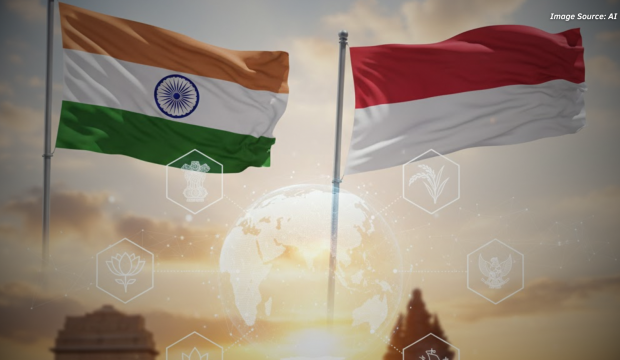
India-Indonesia ties celebrated their 75th anniversary in 2024, marking a significant turning point for two emerging Asian countries. Between 23 and 26 January 2025, the President of Indonesia, H.E. Mr Prabowo Subianto, paid a state visit to India at the invitation of the Indian Prime Minister, H.E. Mr Narendra Modi.9 Additionally, he served as the Chief Guest at the 76th Republic Day celebrations of India. The close bonds between the two countries were reaffirmed by recalling India’s inaugural Republic Day, when the Chief Guest was H.E. Sukarno, Indonesia’s first president. President Prabowo’s visit stood out owing to the participation of 352 members of the Indonesian Armed Forces in India’s Republic Day Parade, forming part of both the marching contingent and the marching band.
Defence Engagement
India and Indonesia are seafaring nations and maritime neighbours. Their relationship is founded on cultural exchanges conducted across the seas, and they hold similar views regarding the changes occurring in the marine environment of the Indo-Pacific region and the wider world.
With more than 1,380 islands and 11,098.81 kilometres of coastline, and possessing an Exclusive Economic Zone (EEZ) of 2.4 million square kilometres, India occupies a central position in the Indo-Pacific.10 Meanwhile, Indonesia, the world’s largest archipelagic state, serves as a pivotal point between the Indian and Pacific oceans. Its coastline extends to 108,000 km, and its 17,504 islands and features encompass a total area of 6,400,000 square kilometres, including the Exclusive Economic Zone.11 The combined maritime region that the two oceans represent is crucial for international marine trade and commerce.
The two sides unveiled a vision document for the Indo-Pacific region, the first of its kind between India and a Southeast Asian nation. This agreement deals with an area where China is expanding its footprint. India agreed to develop the strategically significant Indonesian port of Sabang in the Indian Ocean, near the Andamans. Additionally, 15 agreements were inked between the two parties, including ones pertaining to health, railways, outer space collaboration, and greater defence cooperation during PM Narendra Modi’s visit to the Republic of Indonesia on 29-30 May 2018.12
India and Indonesia signed a defence cooperation agreement in 2001, which called for the creation of the JDCC to investigate and identify possible areas of collaboration and issues of shared interest, as well as to start, coordinate, oversee, and manage the authorised cooperative operations. After that, the two countries have had regular defence exchanges, including the exchange of high-level visits, ship visits, officers studying in Staff Colleges in either country and joint coordinated patrols in the mouth of the Malacca Straits.13
On May 3, 2024, the 7th JDCC meeting took place in New Delhi, where both parties discussed problems of mutual interest on a regional and international level. In recent years, the range of India-Indonesia defence interactions has expanded to encompass high-level visits, military-to-military exchanges, capacity building and training initiatives, collaboration in UN peacekeeping, ship visits, bilateral exercises, and extensive contacts between the services.14 According to news reports of January 11, 2025, Indonesia’s defence ministry has formally initiated a $450 million deal to acquire BrahMos missiles from India.15 According to the sources, the EXIM (Export-Import) Bank was originally supposed to handle the loan to Indonesia, but this never came to pass.16 Deals with countries like the Philippines and potential buyers like Indonesia indicate a strategic shift in military diplomacy as India looks to play a bigger role in the world’s arms exports, especially in an area where China still holds a prominent presence in the South China Sea.17 As the Chief Guest for India’s 76th Republic Day, H.E. Mr Prabowo Subianto was invited to undertake a state visit to India. It had been anticipated that this visit would lead to a BrahMos deal; however, the term BrahMos was conspicuously absent from the official proceedings of the visit. Neither the Aceh-Andaman linkage nor the Sabang port project in Indonesia received any reaffirmation.18
According to Professor Anak Agung Banyu Perwita of Indonesia Defence University, Indonesia:
“Both countries have a lot of opportunities to increase their defence cooperation. We can further strengthen our existing defence cooperation, such as: Joint Patrols & Exercises, IND-INDO CORPAT (coordinated patrols since 2002), and they can increase Maritime Domain Awareness (MDA) Intelligence in the Indian Ocean”.19
As the Chief Guest at India’s 76th Republic Day, H.E. Mr Prabowo Subianto was invited to carry out a state visit to India. Expectations had been high that this visit would culminate in a BrahMos agreement; nevertheless, the word BrahMos was strikingly missing from the official statements during the visit. Neither the Aceh-Andaman connection nor the Sabang port initiative in Indonesia was reaffirmed in any way.
Future BRICS Prospect
On the occasion of the 17th BRICS Summit in Rio de Janeiro, Indonesia was welcomed by world leaders as a full member of BRICS, an intergovernmental organisation comprising ten countries. Indonesia thus became the first Southeast Asian nation to join BRICS.20 BRICS acts as a platform for Indonesia to advocate for and promote the interests of the Global South. By collaborating with other emerging economies like India, Jakarta aims to influence global policies that support sustainable growth, fair trade practices, and access to technology, critical elements in achieving its ambitious growth goals.21 In addition to thanking Russia, the 2024 BRICS chair, for its assistance during the membership process, Indonesia’s Ministry of Foreign Affairs defended the country’s decision to join BRICS by citing its foundation in the values of equality, respect for one another, and sustainable development.22
In 2024, Indonesia’s trade with BRICS nations reached approximately $150 billion, reflecting the bloc’s importance as a trading partner. Expanding this trade is critical to achieving President Prabowo Subianto’s ambitious target of realising 814.6 billion U.S. dollars in investments between 2025 and 2029 to achieve the 8% GDP target.23
Indonesia’s BRICS membership could provide low-cost financing through the New Development Bank (NDB), enabling investment in infrastructure development, which is essential for Indonesia to meet its growth target, according to Indonesian analysts.24 “With its focus on green energy projects, the NDB can help Indonesia reduce its reliance on traditional financial institutions that often impose restrictive conditions,” as several in Kemlu have pointed out.25
Despite Indonesia’s insistence that it be non-aligned, joining BRICS might make relations with the US and the EU more difficult. Indonesia could carefully manage its position to prevent jeopardising its larger foreign policy goals if tensions between the BRICS and the West worsen.26
Prof Perwita further remarks on how India-Indonesia can cooperate more after Indonesia joined the BRICS bloc:
“India and Indonesia can increase the bilateral trade in a more significant way by diversify bilateral trade, and also increasing blue economy engagement in IORA (Indian Ocean Rim Association). Both countries can also amplify the voice of the Global South to the wider multilateral forums.”27
As India and Indonesia are emerging economies in Indo-Pacific with almost similar economic and security issues, the two countries could efficiently increase trade in mutual benefit in sectors such as Auto Components/Parts, Groundnuts, Vegetable Oils, Residual Chemicals and Allied Products etc. As India had a $1.49 billion negative trade balance in June 2025 as a consequence of $321 million in exports and $1.81 billion in imports from Indonesia,28 India’s exports to Indonesia fell $142 million (30.6%) from $462 million to $321 million between June 2024 and June 2025, while imports fell $368 million (16.9%) from $2.17 billion to $1.81 billion.29 Despite this temporary dip in bilateral trade figures, the overall trajectory of India-Indonesia economic relations remains highly promising and upward-bound. Both nations have demonstrated remarkable resilience and strategic foresight in strengthening their partnership, with bilateral trade reaching record levels in recent fiscal years, often exceeding $28-29 billion annually.30 India has emerged as a key market for Indonesian exports, frequently ranking as the third-largest destination in various quarters of 2025,31 driven by strong demand for commodities like palm oil, coal, and other resources that support India’s energy and industrial needs.
Looking ahead with optimism, the two countries are actively pursuing ambitious goals, including the long-standing target of achieving $50 billion in bilateral trade.32 This vision is supported by ongoing efforts to diversify trade baskets, reduce dependencies, and tap into high-growth areas. India’s exports to Indonesia show strong potential in engineering goods, petroleum products, organic and inorganic chemicals, oil seeds, pharmaceuticals, IT services, and automobiles sectors where Indian competitiveness can drive significant gains. Meanwhile, enhanced cooperation in renewable energy, infrastructure development, technology transfer, fintech, and healthcare promises to create balanced and sustainable growth for both economies.
Conclusion
As India and Indonesia commemorate 75 years of diplomatic relations their partnership stands as a testament to enduring solidarity. From co-founding the Non-Aligned Movement in the 1950s to navigating the 2004 Indian Ocean tsunami with swift mutual aid, these two ancient civilizations have woven a tapestry of trust. The upgrade to a Comprehensive Strategic Partnership in 2018, bolstered by President Prabowo Subianto’s landmark visit to New Delhi in January 2025, underscores milestones in defense pacts and cultural exchanges. BRICS Plus, where Indonesia’s accession as the bloc’s first Southeast Asian full member on January 6, 2025, heralds a transformative chapter. India’s warm embrace of this inclusion signals a shared vision for a multipolar world, amplifying bilateral synergies within a Global South chorus. Reimagining engagement here means transcending dyadic ties to multilateral mastery: co-leading de-dollarisation initiatives to fortify economic resilience, harmonizing maritime security in the Indo-Pacific against non-traditional threats, and pioneering space collaborations for equitable innovation.
DISCLAIMER
The paper is author’s individual scholastic articulation and does not necessarily reflect the views of CENJOWS. The author certifies that the article is original in content, unpublished and it has not been submitted for publication/ web upload elsewhere and that the facts and figures quoted are duly referenced, as needed and are believed to be correct.
References
- “Profile – India at a Glance – Know India: National Portal of India.” n.d. https://knowindia.india.gov.in/profile/india-at-a-glance.php.
- “About Indonesia – USINDO.” 2017. USINDO. November 22, 2017. https://usindo.org/information-on-u-s-and-indonesia/about-indonesia/.
- Indianembassyjakarta. n.d. “INDIA – INDONESIA BILATERAL RELATIONS.” Https://Www.Indianembassyjakarta.Gov.In. Accessed June 20, 2025. https://www.indianembassyjakarta.gov.in/pages?id=eyJpdiI6InNJOFdXOVo5eHdRNnk1YiswTlA1eVE9PSIsInZhbHVlIjoiR3h0Y05CWE5xNyt3YXVkZngzZ1lOZz09IiwibWFjIjoiMThmNjk3NzYyMGEyMjVjNGRhNTBmYjdkMjMzOTUwYzM4NjVhYjUwYTk3MDE2YzI4NTZjMmU2MDc3MzNjOTc1MiJ9&subid=eyJpdiI6InZMTjRLZVFUdXowTFFreWlWOEtsYmc9PSIsInZhbHVlIjoic0hxaG1NRUQra0sxRzZYQ1VOZlhHdz09IiwibWFjIjoiYWJhNGViNWE1YjRlOWIwZjZmYTBkODkzNzBkZDQ2NWM0ZGJhZmU3OThmZjEwM2U4YTMwMjlkYWQzMDcwNDc1YSJ9.
- Singh, Gurjit and ASEAN-India Centre at RIS. 2024. “75 Years of India-Indonesia Relationship: A Historical Perspective.” No. 14. AIC Working Paper. https://www.aseanindiacentre.org.in/sites/default/files/Publication/AIC%20Woring%20Paper%20No.%2014%20Amb%20Gurjit%27s%20paper.pdf.
- Jagtiani, Sharinee L. 2022. “‘Foreign Armies Are Functioning on Asian Soil’: India, Indonesian Decolonisation and the Onset of the Cold War (1945–1949).” Cold War History 22 (3): 305–24. https://doi.org/10.1080/14682745.2021.2021888.
- Sengupta, Arjun. 2025. “From Sukarno to Prabowo Subianto: The Evolution of India-Indonesia Ties.” The Indian Express, January 28, 2025. https://indianexpress.com/article/explained/sukarno-to-prabowo-subianto-india-indonesia-9799419/.
- Sengupta, Arjun. 2025. “From Sukarno to Prabowo Subianto: The Evolution of India-Indonesia Ties.” The Indian Express, January 28, 2025. https://indianexpress.com/article/explained/sukarno-to-prabowo-subianto-india-indonesia-9799419/.
- Suryanarayan, V. “PRESIDENTIAL ADDRESS: INDIA AND THE INDONESIAN REVOLUTION.” Proceedings of the Indian History Congress 42 (1981): 549–62. http://www.jstor.org/stable/44141175.
- “India-Indonesia Joint Statement on the State Visit of H.E. Prabowo Subianto, President of Republic of Indonesia (23-26 January 2025).” 2025. Ministry of External Affairs, Government of India. January 26, 2025. https://www.mea.gov.in/bilateral-documents.htm?dtl/38944/IndiaIndonesia+Joint+Statement+on+the+State+Visit+of+HE+Prabowo+Subianto+President+of+Republic+of+Indonesia+2326+January+2025#:~:text=President%20Prabowo%20thanked%20Prime%20Minister%20Modi%20for%20the%20honour%20of,Indonesia%20on%20mutually%20convenient%20dates.
- DST.NEWS. 2025. “India’s Coastline Length Revised to 11,098.81 Km Following New Methodology – DST – Daily Shipping Times.” DST – Daily Shipping Times. May 2, 2025. https://dst.news/news/indias-coastline-length-revised-to-11098-81-km-following-new-methodology/.
- Mea.gov. 2018. “Shared Vision of India-Indonesia Maritime Cooperation in the Indo-Pacific.” Ministry of External Affairs, Government of India. May 30, 2018. https://www.mea.gov.in/bilateral-documents.htm?dtl/29933/Shared_Vision_of_IndiaIndonesia_Maritime_Cooperation_in_the_IndoPacific.
- “Shared Vision of India-Indonesia Maritime Cooperation in the Indo-Pacific.” 2018. May 30, 2018. https://www.pib.gov.in/PressReleasePage.aspx?PRID=1538830®=3&lang=2
- cgibali.gov.in. n.d. “Consulate General of India, Bali, Indonesia : India and Indonesia Bilateral Brief.” Www.Cgibali.Gov.In. Accessed August 1, 2025. https://www.cgibali.gov.in/page/bilateral/.
- Katoch, P.C. 2025. “India-Indonesia Relations.” Spslandforces. January 14, 2025. https://www.spslandforces.com/experts-speak/?id=1221&h=India-Indonesia-Relations.
- DW Bureau. 2025. “Indonesia Initiates $450 Million BrahMos Missile Export Deal: Report.” Defence Watch, January 11, 2025. https://www.defencewatch.in/defence-news/latest-defence-news/indonesia-initiates-450-million-brahmos-missile-export-deal-report.
- Singh, Mayank. 2025. “Indonesia Initiates $450 Mn BrahMos Missile Export Deal.” The New Indian Express, January 11, 2025. https://www.newindianexpress.com/nation/2025/Jan/11/indonesia-initiates-450-mn-brahmos-missile-export-deal.
- Goreja, Rahul. 2025. “India exports second batch BrahMos missile to Philippines via sea.” Business-Standard. April 21, 2025. https://www.business-standard.com/external-affairs-defence-security/news/india-brahmos-second-batch-missile-export-philippines-defence-deal-125042100638_1.html.
- Mehta, Maj Gen Ashok K. 2025. “Why Indonesia Is Holding up Brahmos Deal – the Tribune.” The Tribune, February 14, 2025. https://www.tribuneindia.com/news/comment/why-indonesia-is-holding-up-brahmos-deal/.
- Anak Agung Banyu Perwita, Jakarta, Indonesia (2025), personal interview, Manish Jaiswal, Newdelhi, India, 22 June 2025.
- ddnews.gov.in. 2025. “BRICS: Indonesia joins as full member, 10 countries welcomed as partners.” DDnews. July 7, 2025. https://ddnews.gov.in/en/brics-indonesia-joins-as-full-member-10-countries-welcomed-as-partners/.
- Medina, Ayman Falak. 2025. “Indonesia Joins BRICS: Opportunities and Economic Impact.” ASEAN Business News. January 8, 2025. https://www.aseanbriefing.com/news/indonesia-joins-brics-unlocking-new-economic-opportunities/.
- Fitriani. 2025. “Joining BRICS, Indonesia Sticks With Multi-alignment Strategy | the Strategist.” The Strategist. January 16, 2025. https://www.aspistrategist.org.au/joining-brics-indonesia-sticks-with-multi-alignment-strategy/.
- Huaxia. 2025. “Indonesia Targets 814.6 Bln USD in Investment to Drive 8 Percent GDP Growth by 2029.” English.News. February 10, 2025. https://english.news.cn/20250210/c70da8b024ac42779d6aa94125df331e/c.html#:~:text=Indonesia%20targets%20814.6%20bln%20USD,GDP%20growth%20by%202029%2DXinhua.
- Saha, Premesha. 2025. “Indonesia in BRICS: New Chapter or Familiar Story?” Asiasociety.Org. March 6, 2025. https://asiasociety.org/australia/indonesia-brics-new-chapter-or-familiar-story.
- Ibid
- op. cit.
- Anak Agung Banyu Perwita, Jakarta, Indonesia (2025), personal interview, Manish Jaiswal, Newdelhi, India, 22 June 2025.
- OEC World. n.d. “The Observatory of Economic Complexity.” The Observatory of Economic Complexity. Accessed August 25, 2025. https://oec.world/en/profile/bilateral-country/ind/partner/idn.
- Ibid.
- “TTWTO VCCI – (News) India-Indonesia Trade Reaches US$29.4 Billion in FY2023-24.” n.d. https://wtocenter.vn/chuyen-de/26759-india-indonesia-trade-reaches-us294-billion-in-fy2023-24.
- Ani. 2025. “India Becomes Indonesias 3rd Largest Export Destination in Q2 2025 Amid Trade Shifts: Report – the Tribune.” The Tribune, November 13, 2025. https://www.tribuneindia.com/news/business/india-becomes-indonesias-3rd-largest-export-destination-in-q2-2025-amid-trade-shifts-report/.
- “India, Indonesia Target $50-billion in Bilateral Trade Over Next Six Years.” 2021. BusinessLine. October 28, 2021. https://www.thehindubusinessline.com/news/national/india-indonesia-target-50-billion-in-bilateral-trade-over-six-years/article37210593.ece.

MR MANISH JAISWAL
is a Research Assistant at CENJOWS