
Abstract
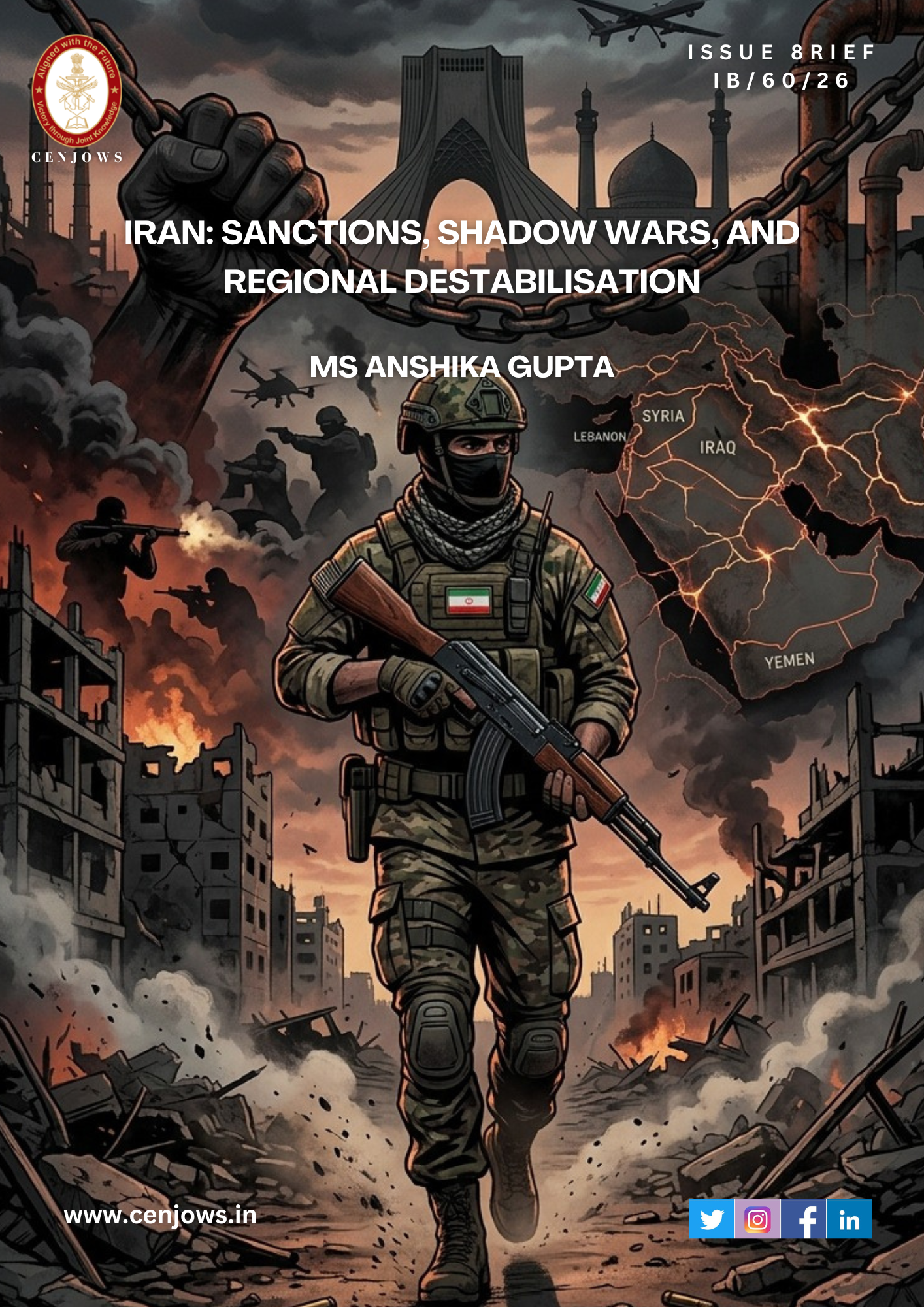
This chapter examines the architecture of United States economic war against Iran and the cascading geopolitical consequences that have fundamentally reshaped West Asia. It traces the evolution of U.S.-Iran hostility from the 1979 Islamic Revolution through the maximum pressure campaigns of the Trump administration, the assassination of Islamic Revolutionary Guard Corps (IRGC)-Quds Force Commander General Qassem Soleimani in January 2020, and the degradation of Iran’s regional proxy network in the aftermath of the October 7, 2023 Hamas attacks and subsequent Israeli military operations. The chapter argues that while U.S. sanctions and covert operations have significantly constrained Iran’s strategic capacity, they have simultaneously created a volatile regional environment with direct consequences for India’s security and connectivity interests. India’s strategic response is marked by the principles of strategic autonomy that has been tested severely by the Chabahar dilemma, the International North-South Transport Corridor (INSTC) calculus, and the broader challenge of balancing its growing partnership with Washington against its long-standing civilisational and economic ties with Tehran. The analysis concludes that India must pursue calibrated diplomatic engagement to protect its core strategic interests in a region increasingly shaped by U.S. unilateral action.