
Views: 37
Key Takeaways
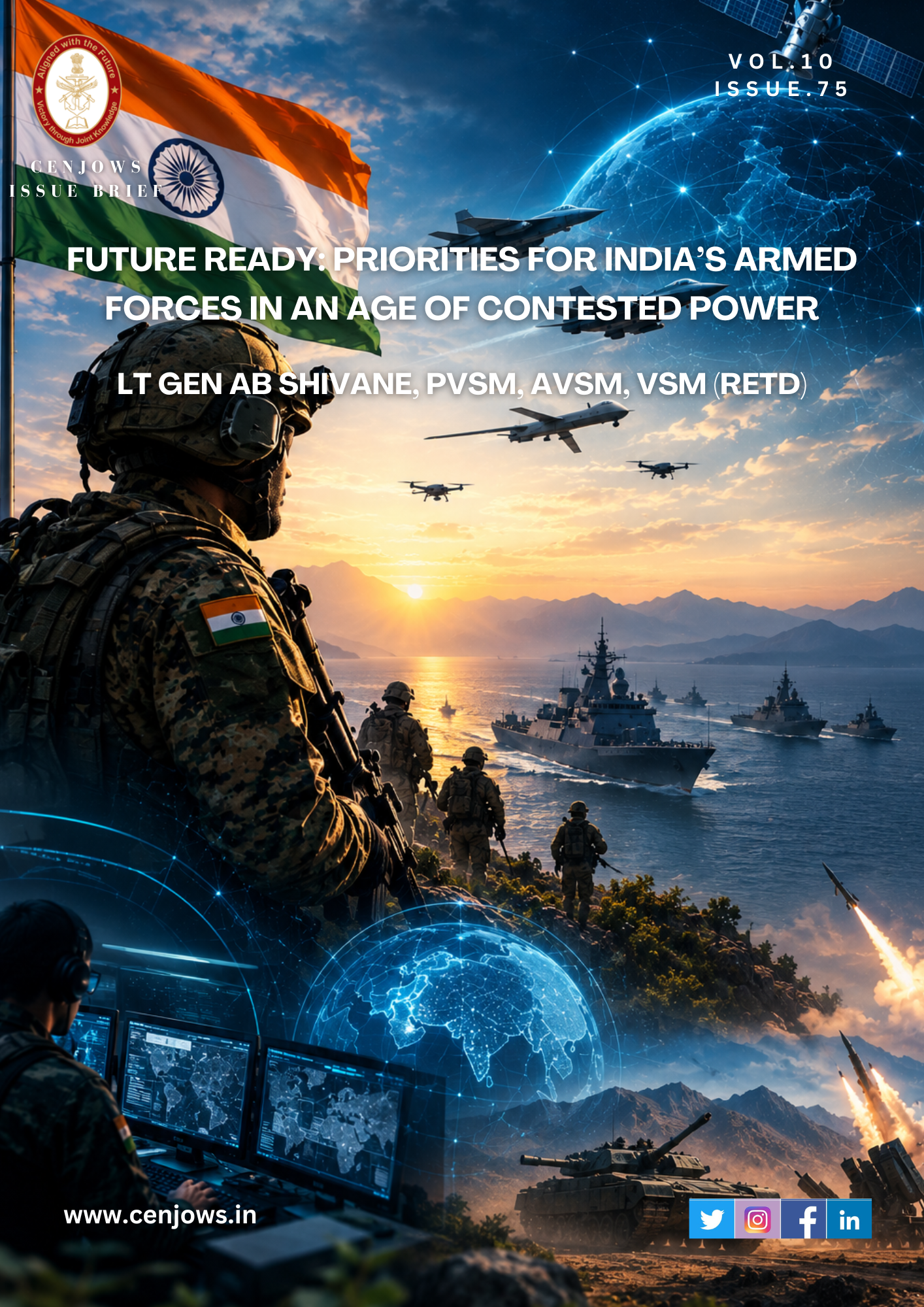
- India faces a two-front reality, made more salient by the deep collusion between China and Pakistan and the emerging factor of Bangladesh, besides an omnipresent internal threat. Future readiness is a whole-of-nation task, not one for the services alone.
- War is becoming faster and more networked. Sensors, shooters, and decision makers must be joined in seconds, not hours, and the force that closes this loop first usually wins the exchange. AI has revolutionised the OODA loop.
- Jointness and theaterisation are the foundation for every other reform. Without a single, integrated chain of command, new weapons and technology will remain suboptimal for desired effects.
- Indigenous capability must move beyond assembling imported designs. The need is for an indigenous capability to design, develop, and manufacture its own weapons at wartime speed and for secure, assured internal supply chains.
- Cyber, space, Cognition, and the electromagnetic spectrum are now front-line domains. Their non-kinetic effects can disrupt an adversary even before the first kinetic action.
- AI should serve as a practical decision-support tool for the Indian Army, fusing data to accelerate decisions. Still, its effectiveness will ultimately depend on clean, secure and shared data, enabled by genuine jointness. Humans must remain on the loop.
- Doctrine, training, restructuring, and leadership determine whether new equipment is actually used effectively in battle. Technology without the right human foundation is an expensive parade piece.
- The last, perhaps most pressing, priority for all is a national security strategy that complements diplomacy, the economy, technology and defence in one document.
Key Words: AI-enabled decision superiority | Sensor fusion | Data-centric warfare | Faster OODA loop | Human-on-the-loop | Jointness | Secure common data | multi-domain integration | Targeting & logistics