
Abstract
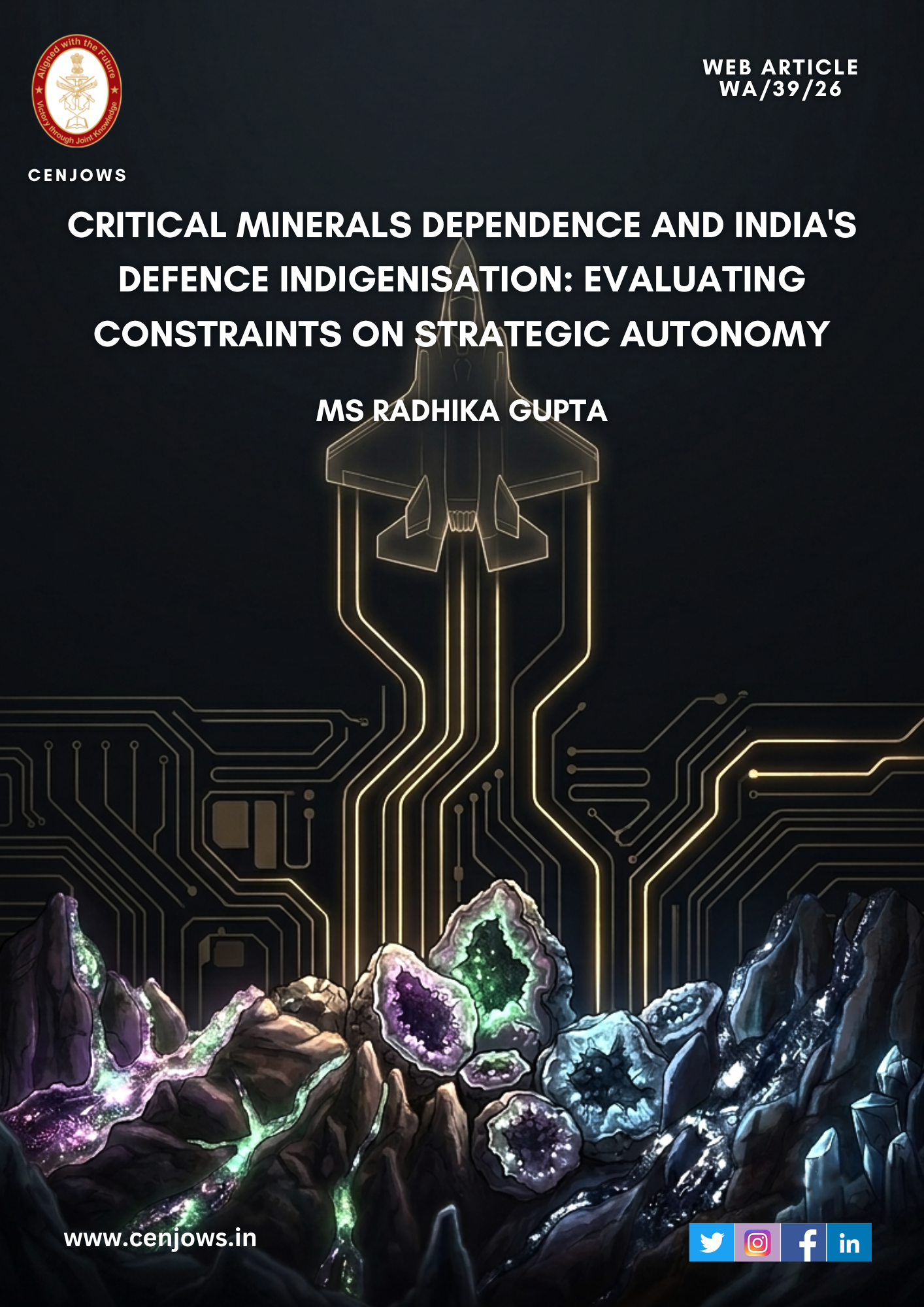
This paper evaluates the intersection of critical mineral supply chains and India’s military modernisation, exposing what it terms the ‘Atmanirbharta Paradox’. While the Atmanirbhar Bharat initiative has accelerated downstream platform assembly and expanded domestic defence exports, this success masks a profound upstream vulnerability. By decoupling downstream manufacturing from material sovereignty, the current paradigm leaves India systemically dependent on external supply chains, most notably those controlled by the People’s Republic of China, for the technological components that drive advanced military hardware.
The study establishes that asymmetric reliance on a primary geopolitical adversary for fundamental inputs like gallium, germanium, and rare earth elements imposes severe material, operational, minilateral, and geopolitical constraints on India’s strategic autonomy. It argues that New Delhi’s contemporary countermeasures, including strategic stockpiling, overseas asset acquisition through KABIL (Khanij Bidesh India Limited), and ‘friend-shoring’ via minilateral frameworks like the MSP (Minerals Security Partnership) and ACITI (Australia-Canada-India Technology and Innovation Partnership), remain insufficient because they fail to address the core deficit in domestic mid-stream processing and advanced metallurgy.
The paper concludes that true self-reliance cannot be achieved through value-based metrics like those in the Defence Acquisition Procedure (DAP) 2020. Instead, it proposes a radical shift toward upstream material sovereignty. This transformation requires three institutional interventions: the convergence of the ministries of defence, mines, and environment to designate ‘Strategic Defence Assets’, the introduction of a Technological Criticality Index (TCI) within the procurement framework, and the aggressive utilisation of defence offsets to de-risk and build out domestic mid-stream refining infrastructure.
Keywords
Atmanirbharta Paradox, Critical Minerals, Defence Indigenisation, Strategic Autonomy, Weaponisation of Interdependence, Mid-Stream Processing, India-China Rivalry.