

Introduction
Rise of China as a maritime great power, fuelled by enormous infrastructure projects along the African littoral, represents a fundamental shift in the great power rivalry dynamics in the Indian Ocean Region (IOR). These investments, often undertaken in the framework of the Belt and Road Initiative (BRI), are more than just commercial ventures, as they are strategically significant dual-use facilities viewed by regional actors, particularly India, as having latent military value. It is argued in this paper that China’s dual-use port strategy is a concerted and effective extension of its national Military-Civil Fusion (MCF) doctrine into effectively making commercial infrastructure capable and dependable strategic military and logistical anchor points. This strategic calculation not only enables the long-term blue-water aspirations of the People’s Liberation Army Navy (PLAN) and its far-seas logistical support needs but also inherently aggravates India’s security dilemma by means of logistical encirclement and the establishment of key maritime information superiority.
The Military-Civil Fusion (MCF) Framework of Dual-Use
The classic definition of “dual-use,” commonly used for technological commodities with both military and civilian uses, falls short of describing the complex strategic depth behind China’s foreign port construction. The uncertainty inherent in dual-use capabilities is a direct cause of the security dilemma, increasing inter-state suspicion as states are unable to distinguish between offensive intentions and defensive modernisation. China has deliberately leveraged this uncertainty through its official state policy of Military-Civil Fusion (MCF). This centrally coordinated doctrine seeks to eliminate institutional and infrastructural barriers between China’s commercial, technological, and defence sectors, effectively creating an integrated, whole-of-society framework. The goal is to accelerate military modernization and advance the development of ‘intelligentised warfare.’’1
With the patronage of MCF, the establishment of advanced dual-use infrastructure was mapped systematically onto the operational objectives of the PLA. This reconceptualises huge commercial investment as a strategically embedded military strategy, allowing the PLA to enhance capabilities without avoiding the diplomatic tension that comes with explicit military expansion. It does this by leveraging the principle of ‘bi-directional and interactive’ fusion, which guarantees innovation exchanges move equally and quickly between the civilian and military domains. Where older multilateral forums like the Wassenaar Arrangement are frustrated from dealing with proliferation threats of advanced technology, China transposes this strategy of fusion into mega-scale, immovable infrastructure. This puts China in an exceptional geostrategic location where its commercial profitability at once finances and hides its long-term strategic interests, essentially trying to turn on its head the traditional ‘guns versus butter’ economic paradigm.
The Strategic Context: MSR and the Role of State-Owned Enterprises
China’s dual-use policy is articulated mainly through the blue-water aspect of the BRI, which is referred to as the Maritime Silk Road (MSR). With China being the world’s leading exporter, biggest shipbuilder, and greatest trading country, China considers having command over the world’s Sea Lines of Communication (SLOCs) as an existential economic as well as military imperative, crucial for the defence of the heavy proportion of its commerce carried by sea. In order to exercise this control, large Chinese State-Owned Enterprises (SOEs), primarily China Communications Construction Corporation (CCCC), China Harbour Engineering Company (CHEC), and China Merchants Group, operate not merely under commercial imperatives but instead as direct tools of state foreign policy.
These SOEs have created a sweeping presence, with an estimated 78 ports currently operating or financed by them in 32 African nations, representing a much larger presence than in any other region of the world. Their typical business model is getting enormous infrastructure contracts together with long-term operating leases and majority equity positions, as in the case of the about 54% financial interest that CHEC has in Nigeria’s Lekki Deep Sea Port. This, in turn, provides the PRC with access that is not only not temporary but deep and possibly irreversible in operational terms. The Chinese operator acquires the ability to decide on pier allotments, grant or refuse port calls, and provide preferential terms to Chinese-flagged ships. Commercial control at this level translates to geopolitical bargaining power and creates basic questions of sovereignty and security for host countries.2 China’s strategic goals are clearly articulated in its Five-Year Plans and its magnum opus doctrine, Science of Military Strategy which focuses on building ‘maritime strategic support points’ to facilitate the development of a ‘strong maritime country.’3
Operationalising Dual-Use Capabilities
The evolution of these commercial ports into strategic assets is attested to by particular physical, logistical, and technological capabilities intentionally embedded into their design and functioning, regardless of the host country’s current intent.
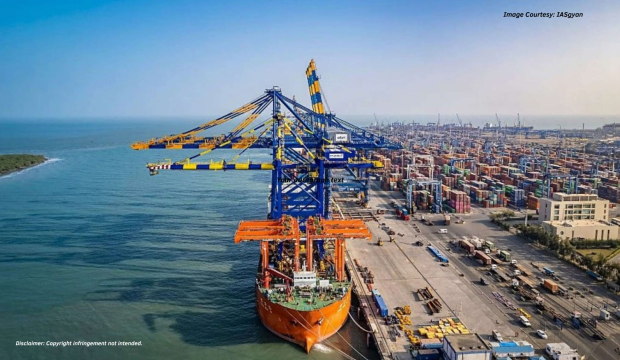
Firstly, most of these African ports are built to hidden military requirements. Satellite images and defence analysis indicate the presence of features like deep-water berths to cater to vessels of 12,000+ tons in size, like the PLAN’s Type 055 destroyer, berth lengths that often surpass 245 meters in length, and strengthened structural capacity to facilitate large naval ships. For example, the recently upgraded Mombasa Port and the deep-water Luanda Port have been verified as being in harmony with PLAN technical requirements for Type 052D and even the new Type 055 destroyers, abilities well beyond typical container shipping requirements.4 These capabilities also involve expanded storage space for material of key importance to facilitate the swift and clandestine deployment of logistics centres.
Second, the ports are the final defence-ready land corridors’ logistical anchors. They are carefully connected with inland infrastructure, like the Standard Gauge Railway (SGR) from Mombasa to Nairobi, or Angola’s Benguela Railway. This integrated land-sea connection constitutes a sanction-proof web of supply lines that can carry military equipment, fuel, and personnel into the African interior.5 This ability is critical for the support of long-range naval deployments and in response to the PLAN’s doctrinal emphasis on far-seas manoeuvring operations.
Third, the ports provide key hubs for intelligence gathering and digital monitoring. China’s technological superiority at sea is utilised for strategic impact. The Chinese company Zhenhua Heavy Industries Company (ZPMC) provides about 70% of the world’s container cranes, some of which are installed with advanced sensors and communications technology. When augmented by the free dissemination of the state-supported Logink digital platform, China gets a virtual ‘God’s-eye view’ of global logistics flows, allowing it to collect and consolidate key real-time proprietary information on ships moving, cargoes carried (including military equipment), and trade data.6 China’s digital superiority threatens India’s commercial and defence supply chains through cyber and intelligence attacks.
Demonstrated Military Use and Future Projections
The effectiveness of the dual-use paradigm has been irrefutably confirmed in the IOR, giving a precise line of action for future military expansion. The primary case study is Djibouti, where a Chinese-led commercial venture was quickly re-purposed as China’s first foreign military base in 2017. Situated near the Chinese-run commercial port on the strategic Bab el-Mandeb Strait, it offers crucial reconnaissance and logistical support. This is highlighted by the upgrade of its naval pier to accommodate heavy combat ships. Similarly, the Port of Mombasa was also upgraded and modernised for Chinese Naval installations. This example verifies the smooth transition from commercial presence to military access, setting a benchmark for expansion in the future.
Apart from this permanent facility, the enormous network of Chinese-owned and operated commercial ports is a key network of support points. The PLAN has shown its dependence on this international presence by making port calls in more than one-third of foreign ports where PRC companies have commercial interests. Particularly in Africa, the PLAN has made around 55 port calls and participated in 19 bilateral and multilateral military exercises since the year 2000. They use harbours along the Atlantic and Indian Ocean coasts, such as Abidjan, Gentil, Durban, and Dar e Salaam. These activities, frequently conducted in the guise of anti-piracy patrols, humanitarian relief, or normal fleet upkeep, are strategically important for a number of reasons. They permit PLAN ships to restock critical supplies like fuel, fresh water, and provisions. They also present chances for non-combatant emergency evacuations, and are used as platforms for military diplomacy, developing interoperability during combined exercises.7
Additionally, the use of Chinese SOEs to conduct military logistics, seen with Hutchison Ports having a terminal at Egypt’s Abu Qir Naval Base, home of the Egyptian Navy, highlights how commercial facilities are being directly included in the PRC’s overseas military sustainment efforts. This trend of widespread access and use validates the commercial ports’ role as anchor points for projecting and supporting distant naval power.
During peacetime and crises, this extensive commercial network offers the PLAN versatile platforms for logistical sustainability, maintaining a constant naval presence in the Gulf of Aden for anti-piracy operations and humanitarian aid. It also offers military diplomacy, as it welcomes combined naval exercises with African states (e.g., Nigeria and Tanzania) to enhance interoperability and legalise its presence. It also provides options for non-combatant operations by utilising the ports as staging bases for evacuations in emergency situations. It is thus projecting soft power in addition to hard capability.8
In the future, rumours about ports such as Bata in Equatorial Guinea on the Atlantic coast indicate China’s desire to project its operational range into the Western Hemisphere. Having an Atlantic coast logistics base would solve key resupply issues for submarines, theoretically projecting their operational range to the extent of creating serious concern for the U.S. eastern seaboard. This reflects China’s ultimate ambition of building a network of logistics that prevents competitors from having unobstructed access and support in the area. However, it is important to state that although these ports augment peacetime power and crisis management, experts largely agree that their use as the bases for combat operations in a high-intensity war would pose grave weaknesses owing to a dearth of special missile defence and bunkered supply bases, requiring major negotiations with the host nation for reinforcements of troops and materiel. But China’s tendency to apply debt diplomacy and coercion to smaller countries makes such an exercise not completely unrealistic.
Strategic Implications for India’s Security
The cumulative result of China’s institutionalised dual-use port strategy constitutes a profound and multifaceted security challenge to India within the IOR.
The most direct strategic impact is the logistical encirclement of India. The chain of Chinese-supported naval outposts, from Gwadar and Hambantota to Djibouti and Kyaukphyu, makes an enduring, geographically contiguous Chinese presence along India’s maritime borders.
This threatens India’s traditional naval dominance and its critical SLOCs, which are vital to its energy security and international trade. In addition, the PRC’s ability to use economic dependence through financial means, as witnessed in the leasing of the Hambantota port for 99 years, provides Beijing with significant political influence over India’s littoral neighbours. This presents a diplomatic headwind that makes these nations receptive to acquiescing to Chinese international interests and reluctant to join New Delhi in the event of a crisis.9
India has responded with an asymmetric and collaborative naval strategy that is represented by its SAGAR (Security and Growth for All in the Region) doctrine. India rebuffs China’s infrastructural aggressiveness not through the effort to equalise capital expenditure, but through creating a resilient web of trust, capacity development, and access arrangements.
India’s approach is to secure strategic logistical access points such as Oman’s Duqm Port and build its own naval capability at home through programmes like the Naval Innovation and Indigenisation Organisation. In addition, India proactively uses its Information Fusion Centre – Indian Ocean Region (IFC-IOR) to engage with East African littoral states on maritime domain awareness, hydrography, and sharing real-time information.10 This strategy is informed by a strategic realism that aims to present India as the more stable and benign ‘Net Security Provider.’ Highlighting transparency, skill-sharing, and multilateral engagements, India’s approach, frequently described as upholding utility at the expense of ubiquity, bodes a long-term pledge for regional stability, thus setting its model apart from China’s extremely transactional and possibly coercive approach. The race in the IOR is therefore not merely characterised by naval resources, but by ensuring the desired regional security framework and long-term necessary political alignment of African and Indian Ocean nations.
Conclusion
The analysis presented illustrates that the PRC’s global port expansion is an advanced strategic campaign, repositioning the function of overseas infrastructure from simply commerce to one of total control. This strategic progression is institutionalised via the Military-Civil Fusion (MCF) doctrine, reconfiguring commercial financing, construction, and operation as tools of state geopolitical and military policy.
The essence of the resultant challenge is the dual-use mendacity in these assets: while superficially designed to maximise trade efficiency, these ports are at the same time designed to military specifications, with deep-water berths and increased structural integrity, and operationalised via data-collection platforms such as Logink. This technological and physical integration allows for the smooth use of these facilities by the PLAN for an entire spectrum of missions, from mundane replenishment to sophisticated intelligence collection and extended-range power projection, a capability attested to by repeated port calls and bilateral military exercises around the African and Indian Ocean littorals.
For India, this intersection of economic coercion and naval access is a high-stakes security dilemma. The core argument made by this paper is that the PRC’s strategy does the logistical encirclement of India. The strategic implications necessitate India balancing on its fingertips: countering the realist military threat posed by the PLAN’s increased reach while at the same time handling the diplomatic and economic weaknesses of its neighbours. The ultimate contest for the Indian Ocean Region, therefore, is not merely one of naval assets but of competing security architectures. The PRC seeks control through infrastructural dominance and financial leverage, while India’s asymmetric SAGAR approach values utility over ubiquity, laying the groundwork for securing the long-term diplomatic and operational space necessary to secure its core interests.
DISCLAIMER
The views expressed in this monograph are solely those of the author and do not necessarily reflect the opinions or policies of CENJOWS. The author affirms that this work is an original piece of scholarly research, has not been published or submitted for publication elsewhere (in print or online), and that all data, facts, and figures cited are appropriately referenced and believed to be accurate to the best of the author’s knowledge.
References
US Department of State, “The Chinese Communist Party’s Military‑Civil Fusion Policy,” accessed November 26, 2025, https://2017-2021.state.gov/military‑civil‑fusion/index.html
Paul Nantulya, “Mapping China’s Strategic Port Development in Africa,” Africa Centre for Strategic Studies, March 10, 2025, https://africacenter.org/spotlight/china-port-development-africa/.
*Chinese Embassy in India*, “Embassy News and China-India Exchanges,” accessed November 21, 2025, (https://in.china-embassy.gov.cn/)
USNI, “Type 055 Renhai-Class Cruiser: China’s Premier Surface Combatant,” *USNI Proceedings*, accessed November 20, 2025, https://www.usni.org/magazines/proceedings/2023/march/type-055-renhai-class-cruiser-chinas-premier-surface-combatant#:~:text=The%20Type%20055s%20are%20fitted,is%20disabled%20in%20your%20browser)
Shreyansh Krishna, “Significance of Mombasa Port for Chinese Outreach in Africa,” *Orfonline.org*, November 11, 2024, (https://www.orfonline.org/expert-speak/significance-of-mombasa-port-for-chinese-outreach-in-africa)
*The Wall Street Journal*, “Pentagon Sees Giant Cargo Cranes as Possible Chinese Spying Tools,” accessed November 18, 2025, (https://www.wsj.com/politics/national-security/pentagon-sees-giant-cargo-cranes-as-possible-chinese-spying-tools-887c4ade)
Daniel F. Runde, Austin Hardman, and Clara Bonin, “Responding to China’s Growing Influence in Ports of the Global South,” *CSIS*, 2024, (https://www.csis.org/analysis/responding-chinas-growing-influence-ports-global-south)
“Dual‑Use Ports Give PRC Proximity to Vital Shipping Lanes,” IPDefenseForum.com, accessed November 20, 2025, (https://ipdefenseforum.com/2023/10/dual-use-ports-give-prc-proximity-to-vital-shipping-lanes/)
Amit Kumar Singh, “Harbors of Power: How China’s African Ports Are Shaping India’s Ocean Strategy,” *Australian Outlook*, Australian Institute of International Affairs, August 6, 2025, (https://www.internationalaffairs.org.au/australianoutlook/harbors-of-power-how-chinas-african-ports-are-shaping-indias-ocean-strategy/)

Ms Khushi Goyal
is a Research Intern at CENJOWS