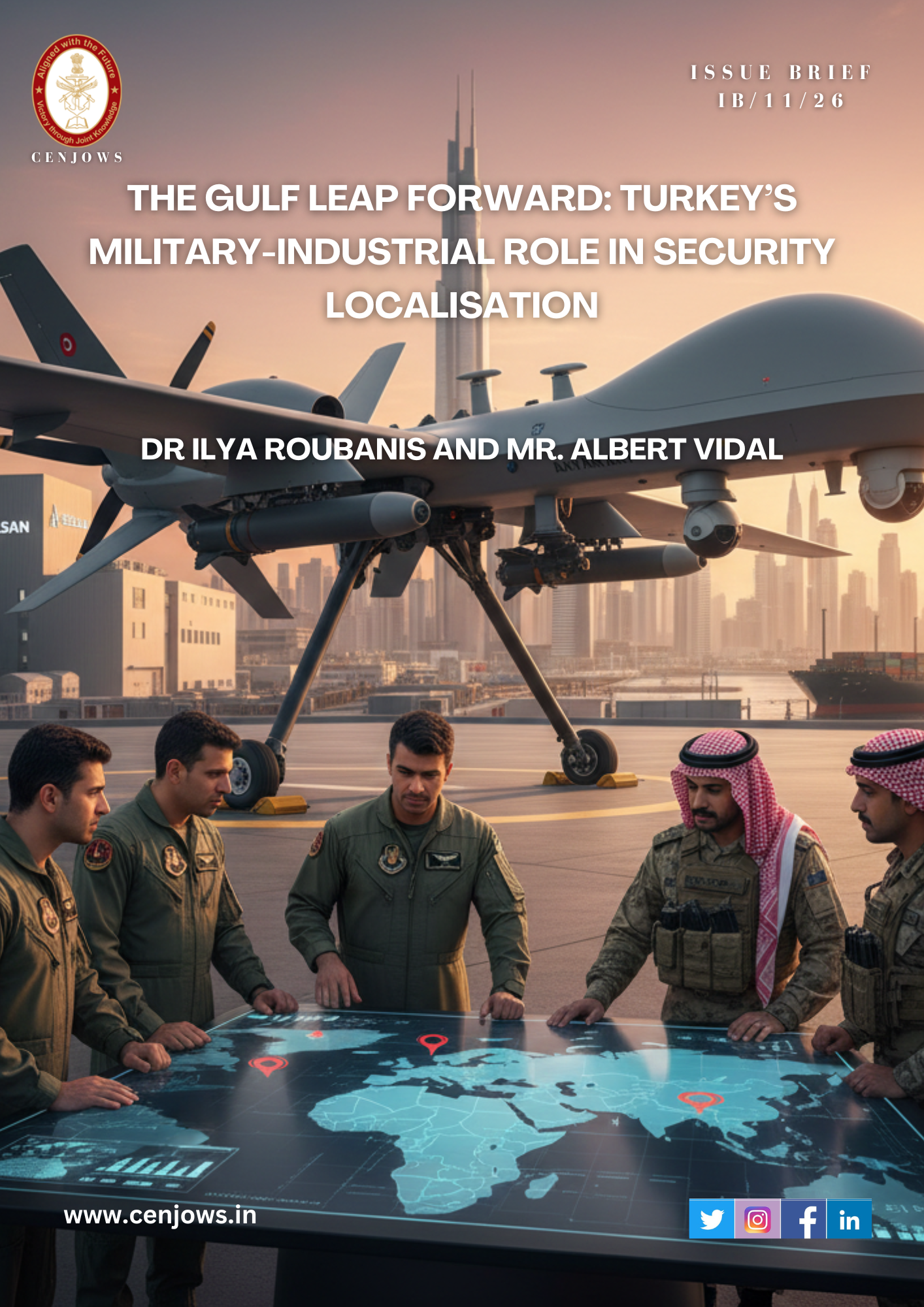

Turkey’s defence diplomacy is defined by localisation sovereignty: the embedding of foreign subsystems, software, and payloads into Turkish platforms, and the adaptation of those platforms to partner doctrines under national control. Localisation sovereignty contrasts directly withbloc‑based conditionality, in which access to platforms, upgrades, and exports is contingent on political alignment with a major power bloc, leaving operational autonomy hostage to supplier discretion. Turkey’s approach instead is open to co‑production, technology transfer, subsystem integration, and the sovereign command of mission software and data links. This posture positions Turkey as an amplifier of Gulf States strategic autonomy, enabling them to localise production, build resilient defence value chains, develop military platforms to respond to the bespoke needs of their own threat environments, and retain their strategic autonomy.
This paper traces how Gulf states, Pakistan, and Turkey have co‑authored a localisation ecosystem. Innovation is driven by integrating subsystems from diverse technological bases, producing hybrids tailored to national strategies. The analysis examines the shift from procurement of standard platforms to co‑production. It shows how dyadic partnerships – Turkey and the United Arab Emirates (UAE), Turkey and the Kingdom of Saudi Arabia (KSA), Turkey and Qatar – are reshaping regional defence logic into new industrial value chains. The main difference between the sum of these bilateral partnerships and other U.S. or European partners is that the Turkish defence ecosystem is more politically reliable (Des Roches, 2017; Reuters, 2025) and strategically more open to technology-sharing, co-production, and bespoke accommodation to indigenous subsystems and payloads (Breaking Defence 2024). Flexibility of this kind is not unique to the Turkish ecosystem – the UAE’s EDGE is working with Dassault to integrate a range of Emirati-produced ammunition onto the French Rafale (Breaking Defence, 2023) – but Ankara offers a more symmetrical partnership that shields operational autonomy rather than pursuing institutionalised dependency.
The argument put forward is as follows: the Turkey–Pakistan axis is a converging military-industrial ecosystem, whose value chains are cemented by cooperation with Gulf Cooperation States. Turkey supplies adaptable platforms and battlefield‑tested systems; Gulf states contribute capital, payload innovation, localisation ambition, and the necessary scale required to create growth momentum; Pakistan provides a specific kind of engineering depth in systems integration from a range of military ecosystems – Swedish, French, U.S., Chinese, Russian – as well as data and doctrinal experience stemming from testing specific platforms in battle.
This convergence is visible in Turkish UAVs equipped with Emirati payloads, planned production of Turkish armoured vehicle in the KSA, Saudi UAVs built under license in Turkey, and Pakistani jet fighters that have Turkish, Chinese, Russian, British and Italian components. Prospectively, the Saudi–Pakistan Strategic Mutual Defence Agreement (Suraj Yadav et. al. 2025) adds a nuclear shadow to this architecture, which may include Turkish membership (Hacaoglu et. al. 2026). Containment of platform data, software, and operational lessons requires an environment conducive to intelligence sharing and strategic alignment, ensures trust and cumulatively generates diplomatic alignment in a closed loop. The Turkey–Gulf–Pakistan axis offers a blueprint for localisation‑based defence integration: adaptable, resilient, and bloc‑independent, suggesting that strategic autonomy is no longer the preserve of great powers. Dyadic localisation alliances now provide middle powers with strategic depth, deterrence, and industrial sovereignty, reducing reliance on great‑powers.