
Introduction
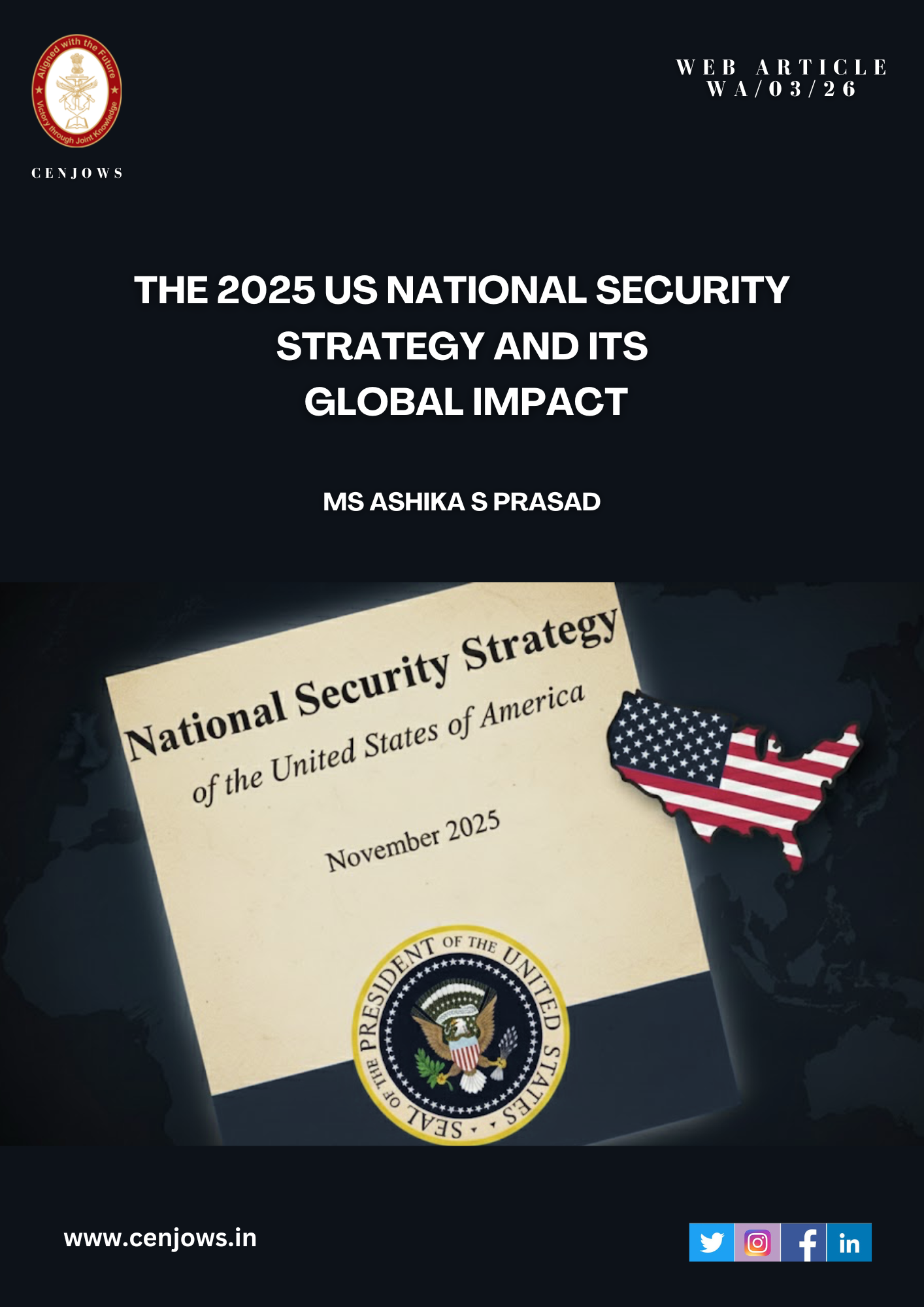
On December 4, 2025, the White House released the National Security Strategy (NSS), signalling a shift in American foreign policy doctrine. The NSS under President Trump marks a turn towards an openly transactional “America First” policy, prioritising concrete deals and direct national advantage. It moves away from emphasising great power rivalry or promotion of democracy, instead focusing on securing regional spheres of influence, protecting economic interests through nationalist policies and enhancing domestic security. This reorientation presents clear implications for allied and partner nations, including India. They will now have to engage with a nation that operates more unilaterally and insists on direct reciprocity. Key expectations from the partners include greater burden sharing by partners, tighter cooperation by allies in securing technology and supply chains etc. Some analysts see it as a renewed and modern Monroe Doctrine to secure its own hemisphere. The document represents a fundamental restructuring of the American leadership with the world, a transition from the “liberal hegemony” paradigm to one of “CivilisationalRealism” and “Hard Sovereignty”.3 This article seeks to analyse the new NSS doctrine and its implications for global order and India in particular.
Framing and Core Themes
The intellectual foundations of the NSS rest on two main pillars: “Civilisational Realism’ and “Hard Sovereignty”. This shows a conscious shift from the universalist values that represented US foreign policy since 1945. American strategy, for decades, stood on the belief that promotion of liberal democracy should be the central goal of US foreign policy.4 The NSS, abandoning this belief stresses on ‘Civilisational Realism’, a perspective that accepts a world organised into separate civilisational spheres, each with its own values and governance logic. The strategy asserts that the United States will be “unapologetic about our country’s past… while respectful of other countries’ differing religions, cultures, and governing systems.”5 A central metaphor used in the document is that of ‘Atlas’, a mythological figure. The doctrine declared that the era of the US acting as ‘Atlas’ “to prop up the entire world is over.”6 This metaphor shows a shift towards a policy of burden sharing and burden shifting.7 It calls upon US allies to assume primary responsibility for security within their own regions. This narrative reframes traditional U.S. global responsibilities. It implies that if the international system weakens because America steps back, the fault lies not with Washington but with allies who failed to shoulder sufficient burdens. This represents a profound psychological shift in national identity, from seeing the U.S. as the “Leader of the Free World” to viewing it as a “Sovereign Republic under Siege.”
Regional Priorities and Selective Engagement
• The Western Hemisphere. The most important geographic pivot in the NSS document is the positioning of the Western hemisphere as the primary strategic theatre. For the first time, Latin America is treated not as strategic backyard, but as a frontline of American defence, named as the ‘Trump Corollary’ to the Monroe Doctrine.9 It identifies three threats to the region- migration, drugs and crime and Chinese influence.10 Countries in the region are presented with a binary choice: integration with the U.S. economic sphere or alignment with a “hostile” external power. The document warns that partnering with U.S. adversaries involves “hidden costs” like debt traps, explicitly aiming to discredit the Belt and Road Initiative.
• The Indo-Pacific and China. The doctrine continues to identify the Indo-Pacific as a region of critical importance, and the framing is more pragmatic and less ideological than in past documents. The emphasis is more towards economic interests and deterrence. The document reaffirms its commitment to uphold freedom of navigation and to secure vital sea lanes, which are significant for global commerce and security. While the Western Hemisphere is the fortress, the Indo-Pacific remains the “decisive theatre” for competition. The strategy introduces the “Core 5” 2framework (US, China, Russia, India, Japan) to manage stability, implicitly accepting a multipolar order.12 The focus is on “collective denial” regarding Taiwan and the South China Sea. Quoting from the document, “Deterring a conflict over Taiwan, ideally by preserving military overmatch, is a priority,” “We will also maintain our longstanding declaratory policy on Taiwan, meaning that the United States does not support any unilateral change to the status quo in the Taiwan Strait.” The 2025 NSS identifies China as the ‘central competitor’ but fundamentally shifts the U.S. objective from transforming China to aggressively containing its reach. Explicitly rejecting the goal of regime change, the strategy focuses on collective denial to prevent Chinese hegemony over the First Island Chain and the South China Sea.14 Economically, the document mandates a rebalancing, utilising targeted tariffs and the “China Plus One” model to strip Beijing of its status as the world’s factory. It emphasises protecting the “AI Stack”, from critical minerals to foundational models, by severing Chinese access to U.S. compute and cloud infrastructure.15 While implicitly acknowledging a Chinese sphere of influence in mainland Asia, the NSS draws a hard red line at the Western Hemisphere, framing the competition not as an ideological crusade, but as a defence of American sovereignty and industrial viability.
• Middle East and Europe. The document states that some of the traditional drivers of the US engagement in the Middle East, oil dependence and superpower competition, have faded with the diversification of global energy sources and the US position as a net energy exporter.16 Even though the region is not abandoned in the document, a clear de-prioritisation is visible relative to the Western hemisphere and other critical economic areas. Europe faces the harshest critique, with the NSS warning of “civilisational erasure” due to migration and a loss of identity.17 Crucially, it seeks strategic stability with Russia and a swift end to the Ukraine war.
• Africa. The mention of Africa in the document is related to the supply chain security, specifically related to the critical minerals such as cobalt and lithium needed for the US defence industrial base. The US’s focus on Africa shifts from traditional aid to infrastructure investment, for example, the Lobito corridor, in order to bypass the logistical networks that China owns in the region. The analysis of the 2025 NSS document reveals the distinct strength of the document, which is rooted in internal coherence and political resonance. It lays down a clear hierarchy of national interests, prioritising homeland security, stability of the Western hemisphere, and economic and technological supremacy. Along with the strengths, it also discusses the significant risks that result from certain strategic choices. The document advocates for burden-sharing and calls to avoid “forever wars,” emphasising non-military means of statecraft.
Analysts identify certain inconsistencies and blind spots in the strategy, which can have wider repercussions. The document’s focus on burden sharing is at odds with the fundamentals of US foreign policy, such as the alliance networks that were the cornerstone of US power. The phrase “great power competition” has been replaced, especially with reference to China and Russia. This is a significant change that could obscure the deterrence message without lessening the likelihood of conflict. There are other risks associated with the new instructions for this strategy. Approving cross-border military strikes against drug cartels, for example, could easily drag the nation into protracted, unpredictable conflicts and go against the long-standing international norm that states respect each other’s sovereignty.
Implications for India
India has fewer mentions in the document compared to China, but when it does mention India, it is in a serious and specific way. India is mentioned in relation to major issues like Indo-Pacific security, securing important raw materials, and cooperation on new technologies. For India, this has two major implications. While this officially raises India’s importance as a key US partner, it also could lead to disagreements on trade and economic issues. The US position is clear: it wants better trade with India for a specific reason. The motivation is to leverage a stronger economic relationship to get India to play a larger role in securing the Indo-Pacific through the Quad alliance. It expects India to act as a “Regional Security Multiplier,” actively policing the Indian Ocean Region (IOR).
This opens up real possibilities for India, mainly in two areas:
• Closer military partnership: The two countries could work together more deeply on defence, from jointly developing new weapons and aircraft to collaborating on maritime security and next-generation technologies.
• A more significant economic role: India has the potential to establish itself as a significant rival to China in the global manufacturing sector by securing essential resources like critical minerals and creating dependable supply chains.
Policy Choices for India
India could concentrate on four important initiatives in light of the new U.S. strategy. India could strengthen actual defence cooperation with the US in those areas like maritime security that actually benefit India. It could also leverage adaptable organisations like Quad to work on common objectives like safeguarding trade routes, instead of forming a close political alliance. India could also expand its relations with European nations and Japan, for instance, to prevent becoming overly dependent on the US. India could also focus on strengthening its defence sector and indigenous technological capabilities. In order to negotiate with the United States from a position of equality and confidence, this domestic strength is crucial.
Global Responses
The strategy has elicited sharp criticism from key European allies, underscoring a significant transatlantic rift. European Council President Antonio Costa condemned aspects of the document as unacceptable, interpreting them as a threat of American interference in European matters.22 Echoing this sentiment, German Chancellor Friedrich Merz stressed the unacceptability of such interference and argued that the lesson for Europe is the pressing need to achieve greater strategic autonomy in security policy.23 From Paris, Alice Rufo, the French director general for international relations and strategy, characterised the NSS as providing “an extremely brutal clarification” of the administration’s ideological stance.24 In stark contrast to this European dismay, the Russian Ministry of Foreign Affairs Official spokeswoman, Maria Zakharova, called it a particularly significant shift in US policy and the Trump administration’s apparent “revision of Washington’s previous commitment to hegemony.”
Conclusion
The 2025 National Security Strategy is a revolutionary document that formally ends the era of American universalism. By adopting “Civilizational Realism,” the United States has signalled that it is no longer the “indispensable nation” for the world’s problems, but a “sovereign fortress” focused on its own survival. For India, the NSS is a vindication of its multipolar worldview but a challenge to its economic model. India is now a “Core 5” power, respected for its civilisation and courted for its military potential. Yet, it must navigate a transactionally ruthless Washington. The era of “strategic altruism” is over. In the world of the 2025 NSS, security is a commodity, alliances are contracts, and every nation must pay its way.